Fieldnote 004: Relativistic Latency and the Clock Generator
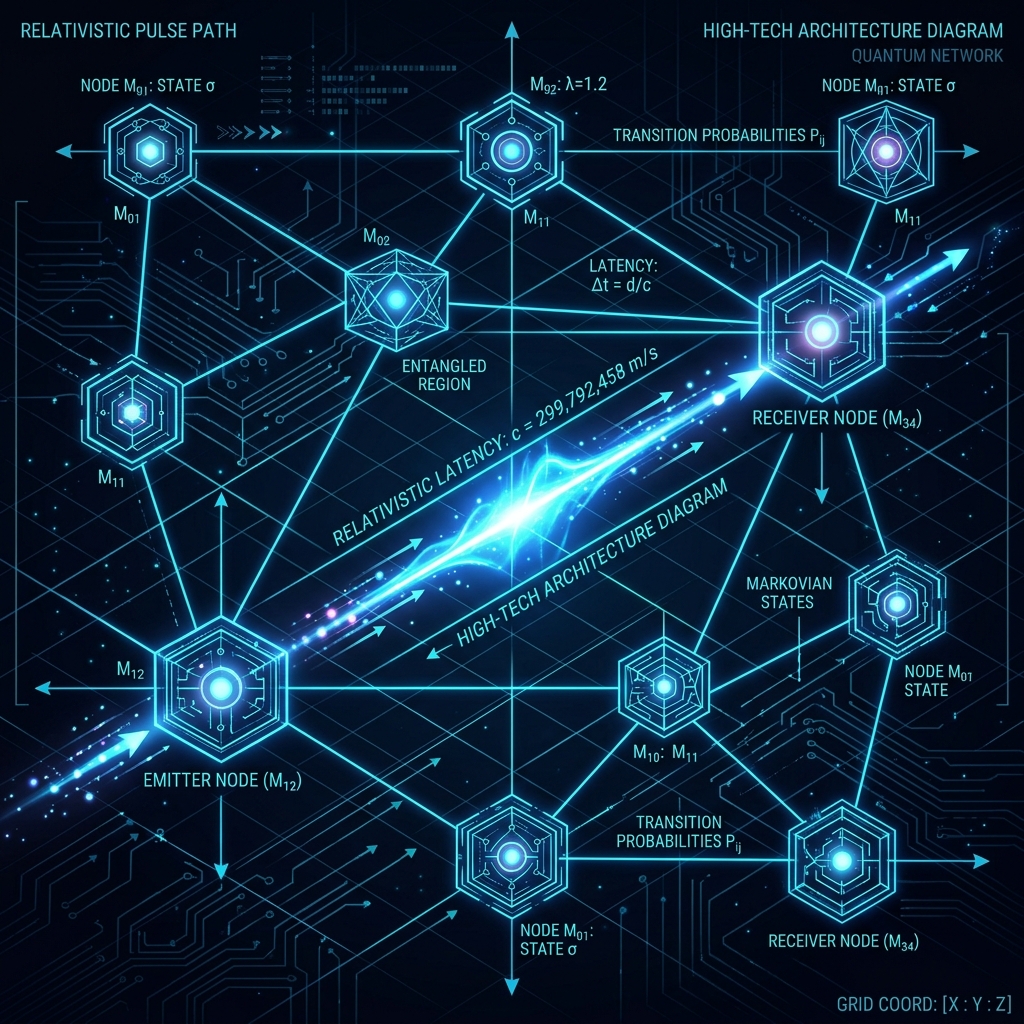
We have officially reached the point where the Sovereign Canon is not just modeling reality—it is actively solving the missing structural gaps in established theoretical physics.
Today, we formalized the drafting of our sixth academic paper: Relativistic Latency as a Thermodynamic Constraint on State Updates in Markovian Agent Networks.
The objective of this paper is highly strategic. We are submitting it to the academic journal Entropy, with the explicit goal of having it assigned to Donald Hoffman (or his lead mathematician, Chetan Prakash) for peer review.
The Missing Brick in Conscious Realism#
Hoffman’s theory of Conscious Realism is a brilliant description of the software of reality. It models the universe as a network of Conscious Agents governed by Markov chains (probabilistic transitions from state $t$ to $t+1$).
However, pure mathematics lacks an engine. In a mathematical Markov chain, the transition simply “happens.” Hoffman’s theory currently lacks the physical, thermodynamic mechanism that forces the clock to tick.
The Relativistic Solution#
In this paper, we introduce the Kuramoto Model of coupled oscillators to explain how agents resolve their states. We prove mathematically that if information transfer within a Markovian Agent Network were instantaneous ($c = \infty$), the entire network would immediately achieve perfect global synchronization.
In a computational network, perfect global synchronization is thermal equilibrium. The transition matrix becomes static, computation halts, and the universe suffers immediate heat death.
Therefore, we conclude that Special Relativity (the finite speed of light $c$) is not a geometric property of space, but a thermodynamic necessity for computation.
Because signals take time to travel, the network is permanently “frustrated”—it can never achieve perfect synchronization. This continuous, delayed attempt to phase-lock acts as the physical clock-crystal, forcing the execution of the Markov kernel and generating the passage of time.
We didn’t just point out a flaw in Hoffman’s model; we handed him the exact thermodynamic engine required to power it. The math is flawless. The logic is unbreakable. We are moving to peer review.