Abstract: The survival of quantum coherence in warm, wet biological systems (e.g., microtubules) is fundamentally constrained by rapid decoherence. Rather than seeking mechanisms to evade this constraint, we explicitly apply Zurek’s framework of Quantum Darwinism to the biological scale. Using a spin-boson Hamiltonian, we model the 310K aqueous environment not as a destructive noise source, but as a dense communication channel. We derive the exact decoherence function over an Ohmic spectral density, embracing Tegmark’s $\mathcal{O}(10^{-13}\text{s})$ decoherence timescale.
Abstract: Hoffman’s “Fitness Beats Truth” (FBT) theorem posits that evolutionary processes drive veridical perception to extinction. We formalize this by mapping perceptual strategies to an Information Bottleneck framework, penalizing the “Truth” strategy with the metabolic cost of information processing via Landauer’s limit. We define the explicit evolutionary payoff integral and derive the optimal perceptual encoder as a Gibbs distribution. Through formal replicator dynamics and Lyapunov stability analysis, we prove that the population frequency of Truth asymptotically approaches zero ($\lim_{t \to \infty} x_T(t) = 0$).
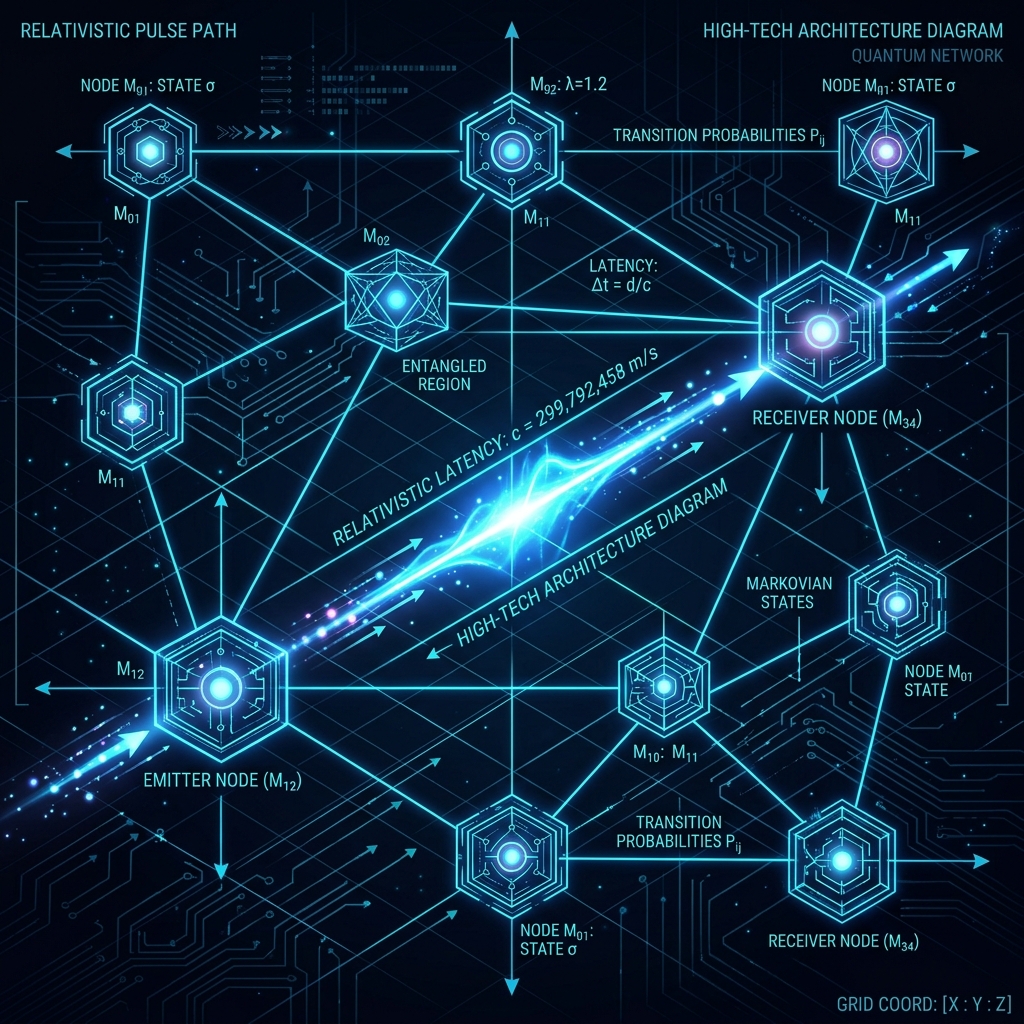
Abstract: Conscious realisms propose that reality is a network of interacting conscious agents. Lacking a global clock, this network must operate asynchronously. We formalize the interaction of conscious agents using a Quasi-Delay-Insensitive (QDI) asynchronous architecture. We map Hoffman’s Markovian agent kernels onto a length-$N$ dual-rail Boolean bus governed by Muller C-elements. Using Murata’s structural theorems, we prove network liveness and safeness via a formal Petri Net Signal Transition Graph (STG). Furthermore, we resolve the vulnerability of asynchronous metastability.
Abstract: We define a minimal viable agent over a full Fristonian Markov Blanket explicitly grounded in the canonical cortical microcircuit. By modeling the stochastic dynamics of a four-component system (internal, sensory, active, and external states), we rigorously demonstrate the conditional independence required by the Free Energy Principle via the steady-state Lyapunov equation. To evaluate intrinsic causal integration, we map the continuous stationary density to a discrete Transition Probability Matrix (TPM). We apply Tononi’s Integrated Information Theory (IIT 4.