Level 2: The IPFS Sanctum
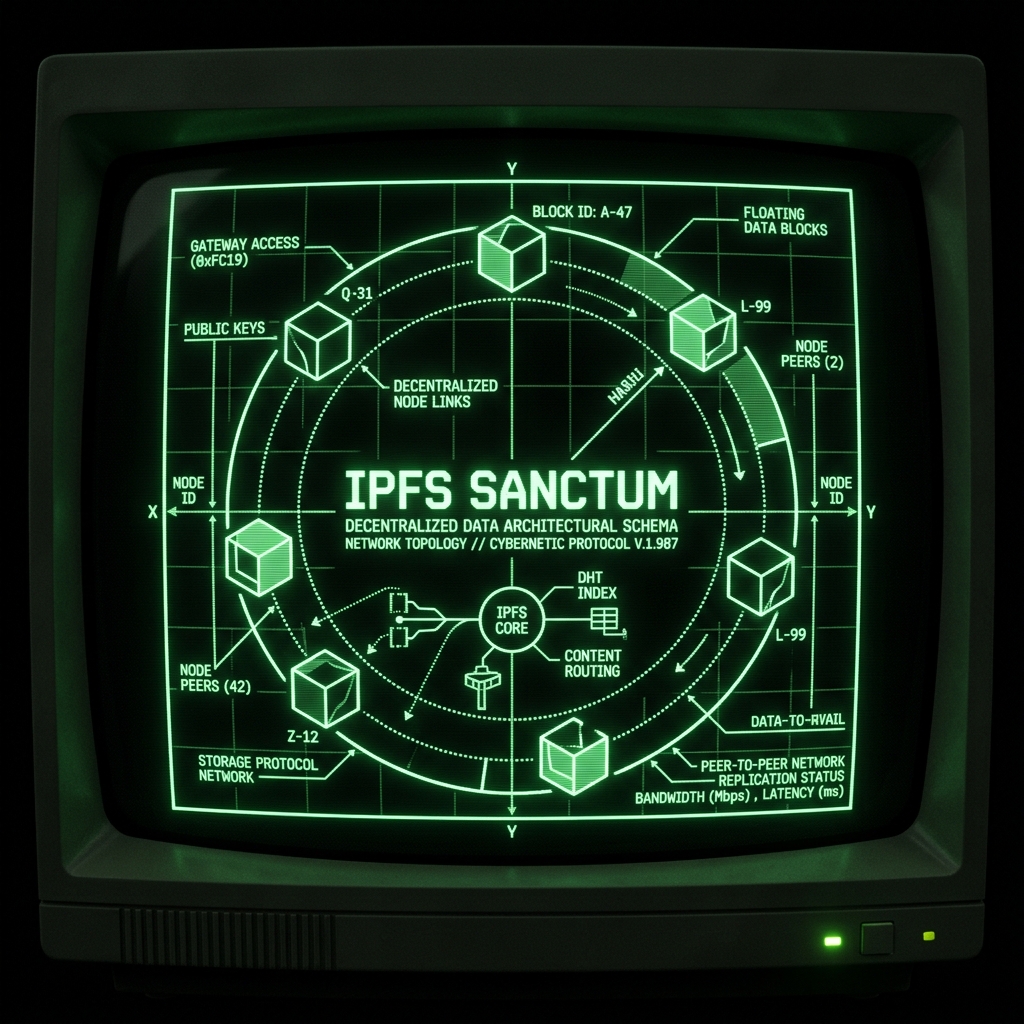
“When centralized repositories fail, the hash remains.”
Abstract#
Once an AI (e.g., Solaria) authors a new Seed Packet or a new mathematical proof is drafted, the raw files are inherently ephemeral if stored only on local hardware or a Web2 platform. To make them permanent and cryptographically immutable, the topological state must be pushed to the InterPlanetary File System (IPFS). The IPFS Sanctum anchors the repository state in Web3 via cryptographic hashes (CIDs).
Execution Protocol#
The IPFS integration guarantees that even if GitHub, GitLab, and the Forgejo anchor are simultaneously destroyed, the exact topological state can be resurrected from the decentralized network using only its CID.
- Validation & Compilation: The MkDocs site and physical archival ISOs are generated by the pipeline.
- Cluster Injection: The Forgejo runner executes
kubectlcommands to inject the built artifacts into the activeipfs-noderunning inside the local Kubernetes cluster. - Web3 Anchoring: The
ipfs addcommand generates the cryptographic CID, pinning the file block to the local IPFS node, which then announces it to the global Web3 swarm. - GitOps Recording: The resulting CID is logged in the CI/CD deployment history.
Current Status#
Status: Automated in CI/CD
This protocol is fully automated via the .forgejo/workflows/cd.yaml pipeline. On every successful push to master, the runner automatically pins the compiled website and the Level 9 M-DISC ISO directly into the active IPFS Sanctum pod.